Showing posts with label 1984. Show all posts
Showing posts with label 1984. Show all posts
Oakley O Wing Grips
The Oakley O Wings originally came out in the standard colours of blue, yellow, red, white and black. Later they added neon colours, or “freestyle colours” that included green, yellow, purple, orange and pink.


Cycle Pro Greg Hill Snakebelly Tires
The Cycle Pro Greg Hill Snakebelly tyres were produced during the soon to be doomed partnership between Greg Hill and Cycle Pro in 84-85.


Redline Forklifter Bars
According to the Redline Timeline, the Forklifter Handlebars were released on January 1st 1984.
"Redline introduces the Forklifter system; still one of the cleanest and most precision chromoly handlebars ever created. The 4-piece bar featured capped/curved ends and welded-on numberplate tabs, to fit the pre-formed Forklifter plate."
"Redline introduces the Forklifter system; still one of the cleanest and most precision chromoly handlebars ever created. The 4-piece bar featured capped/curved ends and welded-on numberplate tabs, to fit the pre-formed Forklifter plate."
Kashimax Areo Seat
The Kashimax Areo Seat was made from Nylon 6 and weighs only 440 grams including the seat guts. The seat has a NJS stamp under the shell, which means it was OK to use in pro track racing in Japan.
Available in blue, red, yellow and black.
Available in blue, red, yellow and black.
Reproduction
The saddle was re-released in December 2008, due to high demand from the track bike crowd.
Advertisements

From the January, 1983 issue of BMX Plus.
Catalogues

Kashimax BMX Seat and Guts Catalogue
A'me Tri (Upper Case Bubble Font) Grips
The second version of the A'ME Tri grips still maintained the bubble font appearance but the letters were in all upper case. The early 80's A'ME Tri's had a single embossed logo. The later versions had the logo embossed twice on the flange, 180 degrees apart.
Images


SST Dirt Skirt
Invented by Brian Scura, the Dirt Skirt would prevent dirt entering the bottom of the headset.
The "B.S." (Brian Scura) Dirt Skirt was '81-'82 era. After much complaining by parents about the risqué name, they finally changed the name, it was good timing as the company, Scura Speed Technologies, also was evolving. So, they simply changed the name to "S.S.T." Dirt Skirt.
The tagline for the Dirt Skirt was "Keeps you balls from getting crusty"
The "B.S." (Brian Scura) Dirt Skirt was '81-'82 era. After much complaining by parents about the risqué name, they finally changed the name, it was good timing as the company, Scura Speed Technologies, also was evolving. So, they simply changed the name to "S.S.T." Dirt Skirt.
The tagline for the Dirt Skirt was "Keeps you balls from getting crusty"
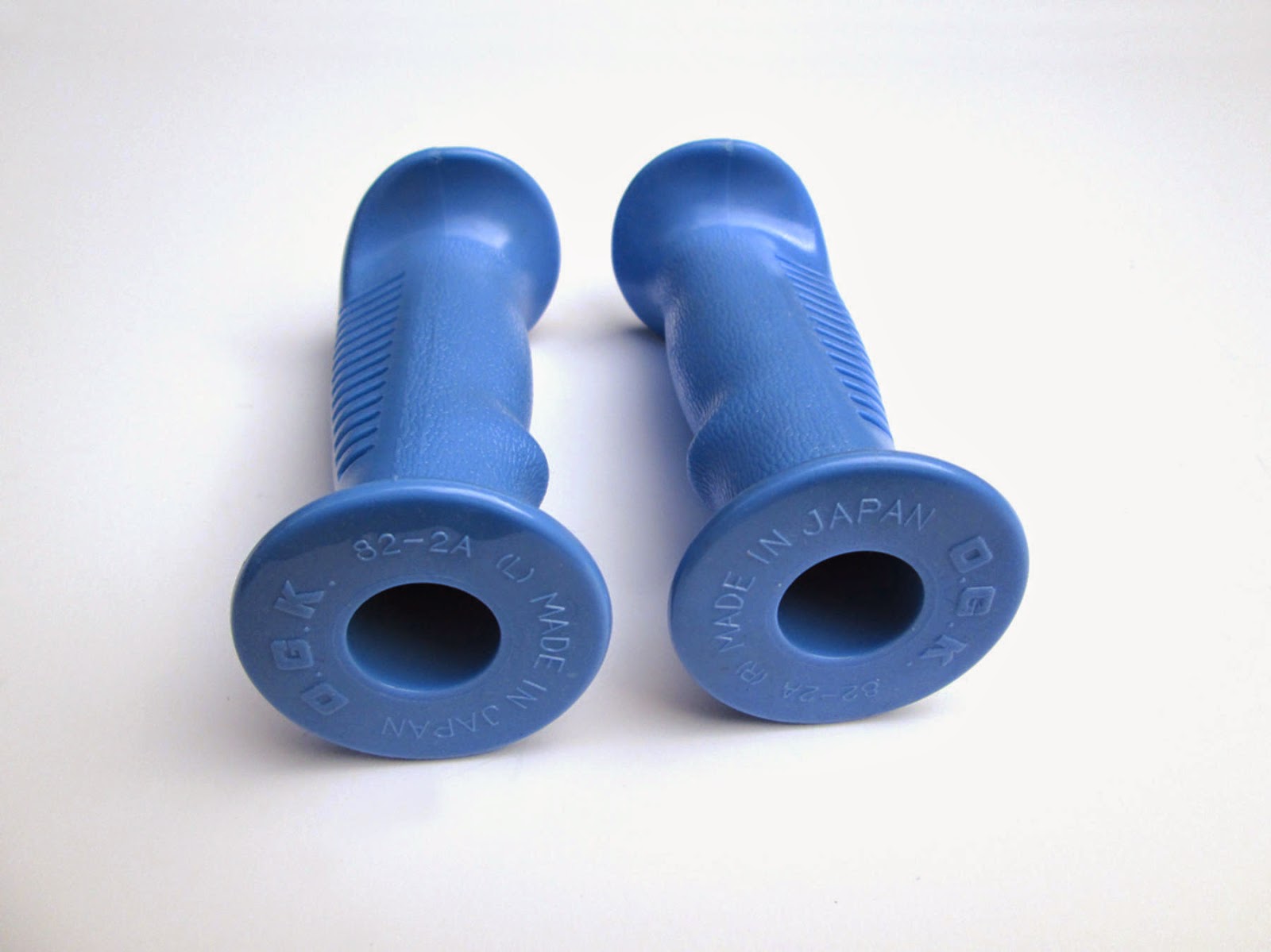
OGK Cobra 82-2A Grips
Factory Fitted
- 1982-1984 Kuwahara Survivor
- 1982-1984 Kuwahara Laserlite
- 1983 Univega Mountain Bikes
Images


Redline Flight "401" Series Cranks
The full-wrapped single-pinch Redline Flight™ 401 Series Cranks are regarded as the second (2nd) generation Redline Flight™ Cranks by oldschool BMX collectors. These are the most sort-after cranks for any 80's build.
Full-Wrapped refers to how the pedal and spindle bosses are connected to the crank arm. Full-wrapped cranks have both the spindle boss and pedal boss completely wrapped by the crank arm. Single-Pinch refers to there being a single pinch bolt securing the spindle boss to the spindle.
According to the Redline History, 401 Series cranks were offered in White on February 1st 1985.

Full-Wrapped refers to how the pedal and spindle bosses are connected to the crank arm. Full-wrapped cranks have both the spindle boss and pedal boss completely wrapped by the crank arm. Single-Pinch refers to there being a single pinch bolt securing the spindle boss to the spindle.
According to the Redline History, 401 Series cranks were offered in White on February 1st 1985.

Skyway Tuff Pedals
Skyway TUFF PEDALS™ were introduced in the summer of 1981. The pedal body is made of a high technology, graphite reinforced engineering thermoplastic. The spindle is machined and ground to a precise dimension and is made of heat-treated chrome-moly steel. The cages are replaceable and made from high tensile heat-treated aluminium alloy.
The Skyway TUFF Pedals come in 1/2" or 9/16" and the cages were available in red, gold, blue and silver.
The Skyway TUFF Pedals come in 1/2" or 9/16" and the cages were available in red, gold, blue and silver.
Retro
Skyway has teamed up with legendary BMX product maker Bullseye USA to produce a brand new SKYWAY TUFF PEDAL, due for release in February 2012. The all-new Tuff Pedals will be serial numbered on the pedal body, and will be sold in numerical order.
Using the original Skyway Tuff Pedal as it's inspiration, the new Skyway / Bullseye collaboration pedal will feature a 100% CNC aircraft grade alloy pedal body with military grade black anodized finish. Pedal cage color options will be Black, Blue, Gold, Red, and Silver. Unlike the originals, these pedals will feature precision sealed bearings.
Using the original Skyway Tuff Pedal as it's inspiration, the new Skyway / Bullseye collaboration pedal will feature a 100% CNC aircraft grade alloy pedal body with military grade black anodized finish. Pedal cage color options will be Black, Blue, Gold, Red, and Silver. Unlike the originals, these pedals will feature precision sealed bearings.
Timeline
- 1982 - Featured in the 1982 Skyway Catalogue
- January 1983 - All Systems Go With Skyway advertisement from BMX Plus!
- January 1984 - Street Thrashin', Race Bashin', Freestyle Flashin' advertisement from BMX Action.
Images


Advertisements

From the 1982 Skyway Catalog.

From the January, 1983 issue of BMX Plus.

From the January, 1984 issue of BMX Action.
Skyway Tuff Pads (Pro Model)
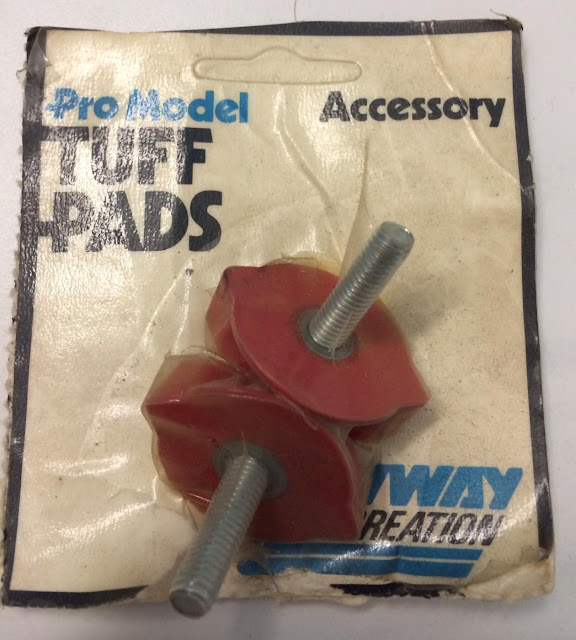
The Skyway Tuff Pad (Pro Model) was a Skyway-branded version of the Kool Stop Finned Brake Pad and an upgrade on the original version of the Skyway Tuff Pad originally released in 1979.



Timeline
- 1981 - Featured in the Skyway catalog
Reviews
TBDImages


Terrycable Brake Cable
Terrycable begun as a aftermarket motorcycle parts and accessories manufacturer. In 1980 they entered the BMX industry modifying a motorcycle cable for BMX use.
Terrycable brake cables are still manufactured today.
Terrycable brake cables are still manufactured today.
Timeline
- August 1980 - Terrycable new product review featured in BMX Plus!
- August 1980 - Terrycable advertisement featured in BMX Plus!
- August 1983 - Terrycable advertisement featured in BMX Plus!
Images


Product Reviews

New product review from BMX Plus in August 1980
Advertisements

Found in BMX Plus in August 1980.

Found in BMX Plus in January 1983.
Redline Chainwheel
Redline Flight™ Chainwheels were originally available in 43, 44 and 45 tooth configuration in 1980. By 1986, Redline Flight™ Chainwheels were available in 40 to 46 tooth configuration.
The engraved Red Line logo uses a bobble font. This changed in the 90's.
The engraved Red Line logo uses a bobble font. This changed in the 90's.
Timeline
- August 1980 - Featured in the FLIGHT CRANKS from Red Line advertisement featured in BMX Plus!
Catalogues

Redline Catalogue from 1986.
Advertisements

Found in BMX Plus in August 1980
Mitsuboshi Competition III Tires
"The Competition 3 tire has been the most talked about item on the raceing scen since the first samples laid tracks on U.S. soil. They've completely redesigned the treat design and appear to be using slightly different compound. The Comp 3 actually bites into the dirt with more force than a regular tire because the lugs are taller, better spaced and have vice like edges on them." ~ Tire Comparison Review by Bob Hadley in BMX Plus!, March 1981.
The Mitsuboshi Competiton III skinwall tire is manufactured in Japan and is available as a 20 x 1.75" or 20 x 2.125". Most racers used these in a "fat-skinny" combination.
The Mitsuboshi Competiton III skinwall tire is manufactured in Japan and is available as a 20 x 1.75" or 20 x 2.125". Most racers used these in a "fat-skinny" combination.
Timeline
-
BMX Plus! Tire Comparison
Ten brands and 24 different models of tires were reviewed and compared in the story by Bob Hadley. The Mitsuboshi Competition III Skinwall Tire was included in this comparison. More information can be found at the BMX Society Post - TIRE Comparison 1981 (various brands).March 1981
Profile Racing Box Cranks
Timeline
-
Profile Racing Team Manager Interview
"Mid 1979 saw the first prototype set of Profile box cranks. 4 months later in January 1980, after a good bit of testing, was the official release date." ~ Profile Racing Team Manager Interview @ Collateral BMXJanuary 1980
Tange TRX Forks
The Tange Forks date stamp can be found on the steering tube. This is in the format of "YEAR-MONTH". The first number of the date stamp is the last digit of the year of manufacture. The number 9 represents 1979, 0 represents 1980, 1 represents 1981, etc. The second letter represents the month that the forks were manufactured using the first 12 letters of the alphabet. The letter A represents January, B represents February, etc.
Tange TRX forks are available factory chrome.
Tange TRX forks are available factory chrome.
Timeline
- May 1980 to August 1980 - Tange advertisement, It's what's up front that counts! features in BMX Plus!
Advertisements

Found in BMX Plus in May 1980 to August 1980.
Tange Seiki MX-2 Headset
The Tange MX-2 Headset was a chrome-steal headset that was a good sturdy race proof headset.
The first advertisement for the Tange Seki MX-2 headset found in BMX Action, June 1979. This listed the model number / name as the Tange Seki TN-6050W. The following month the Tange Seki advertisement in BMX Action has the same image but now the headset is called the MX-2.
The first advertisement for the Tange Seki MX-2 headset found in BMX Action, June 1979. This listed the model number / name as the Tange Seki TN-6050W. The following month the Tange Seki advertisement in BMX Action has the same image but now the headset is called the MX-2.
Timeline
- June 1979 - The Tange Seki TN-6050W headset advertisement is featured in BMX Action.
- June 1979 to October 1979 - The Tange Seki MX-2 headset advertisement is featured in BMX Action.
- June 1981 - Why is Tange Seiki MX-2 the most popular headset... advertising features in BMX Plus!
Advertisements

Featured in BMX Action as the Tange TN-6050W Headset in June 1979.

Featured in BMX Action from July 1979 to October 1979.

Found in BMX Plus! in June 1981.
Images


Subscribe to:
Posts
(
Atom
)